There is something about sending a child off to college that can make even the most organized mothers lose all sense of proportion.
And if you’re anything like me — the kind of mom who likes everything organized, planned, and handled down to the last detail — college move-in shopping can take that to an entirely different level.
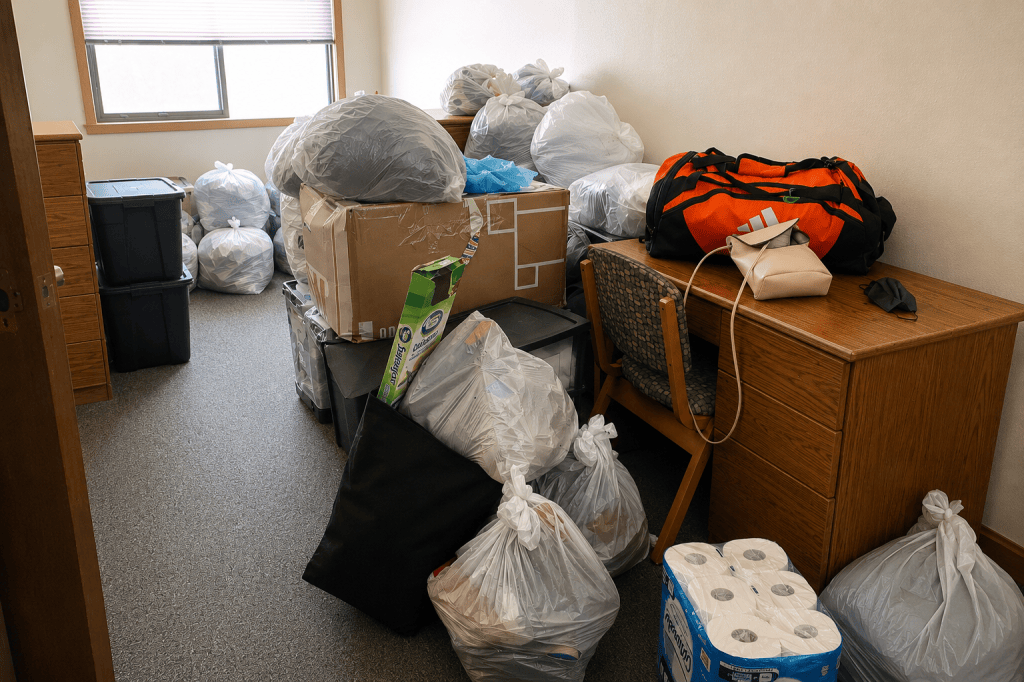
Add all the emotions that come with realizing your child is leaving home and you’re entering a new season too, and suddenly a dorm room that is roughly the size of a walk-in closet feels like it needs the inventory of a small apartment.
Extra towels. Extra sheets. Storage bins. A mini vacuum. A lamp. Another lamp. A chair. Maybe a little sofa. A printer. Enough toiletries to survive until graduation.
And somehow, by the time move-in day arrives, your car looks like you’re relocating an entire household instead of one college student.
I know because I’ve been there.
After four years of college move-ins, move-outs, packing, unpacking, hauling things up and down, figuring out what was actually used and wondering why on earth we bought certain things in the first place, I learned something I wish I had understood from the beginning:
Don’t shop for move-in day. Shop for dorm life.
Those are two very different things.
Before You Buy Anything, Find Out What the Dorm Already Has
One of the things I would do first is check the university’s housing information carefully before beginning the big shopping trips.
What furniture is already provided? Is there a desk? A desk chair? Under-bed storage? A dresser? What size is the mattress? Are microwaves allowed? What about coffee makers, air fryers, extension cords, candles, or other appliances?
Every university has its own rules, and knowing them ahead of time can save you from buying things that eventually come right back home.
If your student has a roommate, this is also a good time for them to talk and coordinate.
A small dorm room probably doesn’t need two microwaves, two TVs, two mini refrigerators, and two of everything else.
A little coordination can save money — and quite a bit of precious dorm-room space.
Shop for the Student You Actually Have
This may be one of the biggest lessons I learned.
It is incredibly easy to start shopping for the imaginary college student we’ve created in our heads.
The one who suddenly becomes extremely organized, folds every piece of clothing, vacuums three times a week, prepares healthy snacks, keeps a beautifully styled desk and somehow remembers to wash decorative throw pillows.
I may have briefly met this student in my imagination.
But eventually I realized that the things most likely to work in college were the things that made sense for my actual child.
If your student likes things simple, keep them simple. If organization isn’t exactly their greatest passion, look for solutions that make staying somewhat organized easier. If they couldn’t care less about décor, you probably don’t need to create an elaborate Pinterest-worthy dorm room they never asked for.
And if they love decorating and making a space their own, then that’s part of the experience too.
The point isn’t to create the perfect dorm room.
It’s to create their dorm room.
Bedding: You May Need Less Than You Think
First, check the mattress size. Many college dorms use Twin XL, but it’s always worth confirming with the university.
For us, the practical approach ended up being fairly simple:
- A good mattress protector or pad
- Two sets of sheets
- Pillows
- A comforter
- A blanket
Two sets of sheets worked well because there could be one on the bed and another available while the first was being washed.
I also came to appreciate bedding that was comfortable but practical. Dorm life isn’t necessarily the easiest environment for delicate fabrics or anything that requires complicated care.
And yes, at some point your child will technically be responsible for washing all of this.
How consistently that happens may be another article entirely.
The Bathroom Situation
If your student will be using a communal bathroom, convenience matters more than I initially realized.
A lightweight, quick-drying shower bag or caddy that can hang can make those trips back and forth much easier. Shower shoes are another simple addition that makes sense in a shared bathroom.
For towels, we found that about four bath towels worked well.
You may decide your student needs more or fewer, of course. The thing I eventually learned was simply to remember that towels take up quite a bit of space — both in the closet and in the laundry.
Laundry: Think About the Trip, Not Just the Hamper
A laundry basket can look perfectly practical sitting in a bedroom at home.
Then you imagine someone carrying it down a hallway, into an elevator, across a building or down several flights of stairs.
That changed how I looked at laundry storage.
Something lightweight, compact and easy to carry can make much more sense than something bulky.
It’s one of those little things that becomes clearer once you stop picturing move-in day and start picturing an ordinary Tuesday three months later.
Storage: Think Up Before You Think Out
Dorm rooms usually don’t offer much floor space, so vertical storage can be incredibly helpful.
Under-bed storage can also work beautifully if the bed allows for it.
But this is another area where I learned not to feel as though every inch had to be organized before move-in.
It’s easy to buy coordinating bins, baskets and organizers when you’re standing in a store imagining where everything might go.
Sometimes it’s better to begin with the basics and let your student live in the room for a little while.
That empty corner may eventually need storage.
Or it may turn out that having an empty corner is actually quite nice.
Food and Water: Think About Their Real Life
A reusable water bottle is useful for most students, and depending on the campus and your student’s preferences, keeping some water in the room may make sense too.
I also liked knowing that my son had snacks and a few easy food options that he genuinely enjoyed.
His university was relatively small, he didn’t have a car at first, and the winters were cold. There were days when going somewhere else for food wasn’t particularly convenient, and like many college students, there were also times when he simply got tired of eating from the meal plan.
Having something familiar in his room — including things that could occasionally substitute for a quick meal — gave him options and gave me a little peace of mind.
What I learned wasn’t to buy less food simply for the sake of buying less.
It was to buy what my student would actually eat.
And when it ran out, we could always send more.
Cleaning: Small and Simple Worked for Us
One purchase I genuinely found useful was a small, lightweight stick vacuum.
Nothing elaborate.
Just something compact enough to store without taking over the room and easy enough to grab when needed.
The same philosophy worked well for other cleaning supplies. A few basic things that fit the space and the student’s habits were more useful for us than trying to recreate the cleaning cabinet we had at home.
Whether that vacuum gets used as often as we imagine when we’re purchasing it is, once again, between the student and the vacuum.
Electronics: Start With What They Actually Use
A laptop is essential for most students.
Beyond that, I would look at the individual student and the campus.
A TV, gaming system or other electronics may make perfect sense if they’re things your student enjoys and will genuinely use.
Before buying a personal printer, though, it’s worth checking what the university already provides. Many campuses offer student printing, and depending on their needs, that may be enough.
For me, this became another version of the same question:
Will my child actually use this?
Sometimes the answer is absolutely yes.
Sometimes it’s something we think they’re supposed to have because it appeared on a dorm checklist.
Let the Room Feel Like Theirs
Being practical doesn’t mean the room has to feel impersonal.
Photos, LED lights where permitted, a favorite blanket, familiar objects or a few things your student chooses can make an unfamiliar space start to feel like home.
And I think that part matters.
For many students, this is the first space they’ve ever had away from home. Letting them decide what makes it feel comfortable and familiar can be part of the transition.
Some students will want a coordinated room.
Others will be perfectly happy with a comforter, their electronics and approximately three things hanging on the wall.
Both are valid.
Shop for Where They’re Going, Not Just Where They’re Coming From
This became especially important for us because my son went to college somewhere with a very different climate from Puerto Rico.
The weather on move-in day isn’t necessarily the weather they’ll be living in a few months later.
What will October feel like? January?
Will they need a real winter coat? Rain gear? Boots? Different bedding?
You don’t necessarily have to purchase every seasonal item before move-in, especially when storage is limited. But knowing what’s coming helps you plan for what they’ll need as the semester changes.
And when you’re sending your child from Puerto Rico into an actual winter, you discover very quickly that “cold” is a relative term.
Things I Would Think Twice About Buying
There are a few things that sounded much more useful to me before move-in than they did after living through dorm life.
Cheap folding chairs and bulky lounge furniture are high on that list.
A little sofa or extra chair can look adorable in a dorm inspiration photo. And if your student has the space and genuinely wants one, wonderful.
But I would first think about how much room it takes up, how often it will actually be used and — perhaps most importantly — what eventually happens to it.
The same goes for oversized storage systems, duplicate appliances and some of those just in case purchases that have a way of multiplying during dorm shopping.
Which brings me to the question I wish someone had taught me before our first move-in.
Ask the May Question
Before buying something large for a dorm room, ask:
What happens to this in May?
This question became increasingly important to me after experiencing move-out.
Because everything we lovingly carry into that dorm in August eventually has to come back out.
Every chair.
Every storage unit.
Every appliance.
Every decorative object that suddenly nobody remembers being quite so excited about nine months earlier.
Will it fit in the car?
Will you store it over the summer?
Will your student use it again next year?
Can it be donated?
Was it useful enough to justify moving it again?
The May Question has an amazing ability to make an August “necessity” look considerably less necessary.
The 48-Hour Rule
This is another thing I would tell first-time move-in me:
Move your student in.
Make the bed. Put away the clothes. Organize the basics.
And then, unless something is genuinely needed right away, give the room a little time before buying everything you suddenly think is missing.
Forty-eight hours can tell you a lot.
Maybe that empty corner really does need another storage unit.
Maybe the desk could use an organizer.
Maybe there’s something you never thought to buy that becomes immediately obvious once your student starts using the room.
Or maybe it’s perfectly fine.
Living in the space — even briefly — tells you things that a dorm checklist simply can’t.
You Can Send More Later
This was another lesson that helped me relax a little.
Your student doesn’t need to begin the semester with an entire academic year’s supply of toiletries, detergent, snacks and every other consumable item.
Things can be replenished.
Toiletries run out. Laundry detergent gets low. Favorite snacks disappear at an alarming rate.
You can send more.
Care packages can also become a lovely way of sending a little piece of home once the excitement of move-in has passed and regular college life begins.
I loved putting together care packages with some of my son’s favorite things — snacks he liked, little things he needed, and sometimes something completely unnecessary that I knew would make him smile. It was one of those small ways I could still take care of him from far away without actually being there.
And sometimes knowing that there will be another box from home arriving soon feels good for both of you.
What I Would Tell Myself Before That First Move-In
If I could go back to that first college move-in, I don’t think I’d tell myself to buy a better organizer or add another item to the checklist.
I’d probably tell myself to relax a little.
This isn’t about getting everything exactly right before you leave campus.
Your child is beginning to figure out how to live independently, and in a different way, you are beginning to figure out how to let them.
That’s part of the transition too.
I’d still make my lists. Let’s not get carried away.
I’d still organize.
I’d still make sure he had the things that made me feel better about leaving him there.
But I’d buy a little more intentionally.
I’d buy for the child I actually had, not the college student I imagined I was supposed to prepare.
I’d give the room — and both of us — a little space to figure things out.
And every time I was tempted to put one more large item into the cart, I’d ask:
What happens to this in May?
Because after four years of college move-ins and move-outs, I can tell you this:
You’ll remember carrying it back out.




Leave a comment